Carbon Monoxide (CO) - Primary Monitoring Target
Source: Produced by incomplete combustion in automobile engines, especially during vehicle
startup, idling,
and low-speed driving.
Hazards: Colorless and odorless, it has a strong binding capacity to hemoglobin, leading
to hypoxia, headaches, coma, and even death. It is the most significant safety threat in parking lots.
Nitrogen Oxides (NOx, mainly NO and NO2)
Source: Produced by high-temperature combustion in automobile engines.
Hazards: NO2 and other compounds are irritating and can damage the respiratory tract;
long-term exposure
increases the risk of illness. It is also a precursor to photochemical smog.
Carbon Hydrocarbons (HC) and Volatile Organic Compounds (VOCs)
Source: Gasoline evaporation and exhaust emissions.
Hazards: Some are toxic and carcinogenic (e.g., benzene), and are important precursors to
ozone and fine
particulate matter.
ustible gases (mainly methane CH2, and gasoline vapor)
Sources: Possible minor leaks from CNG vehicles, gasoline vapor accumulation.
Hazards: When concentrations reach the lower explosive limit, they may explode upon
contact with an open
flame or electrical spark, posing a significant safety hazard.
Carbon dioxide (CO2)
Sources: Main component of vehicle exhaust, human respiration.
Hazards: High concentrations of CO2 (> 1000 ppm) can cause stuffiness, fatigue, and
decreased
concentration;
it is an indirect indicator of air freshness and ventilation efficiency.
Combustible gases (mainly methane CH2, and gasoline vapor)
Sources: Possible minor leaks from CNG vehicles, gasoline vapor accumulation.
Hazards: When concentrations reach the lower explosive limit, they may explode upon
contact with an open
flame or electrical spark, posing a significant safety hazard.

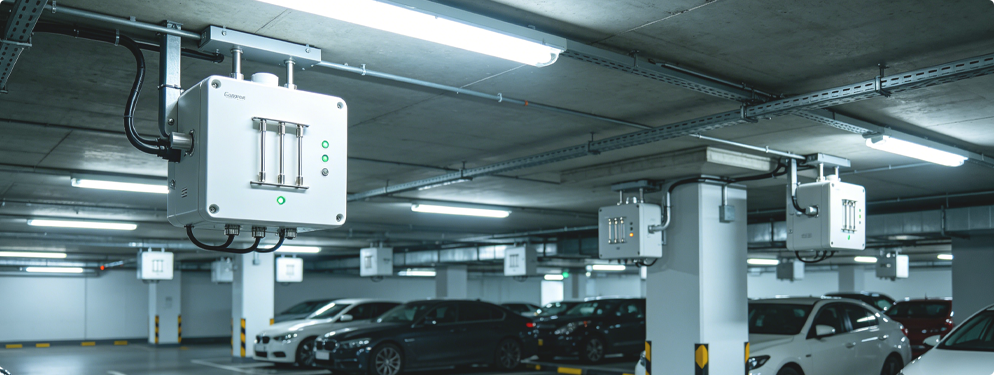
Ventilation-linked control system (core application)
Location: Evenly distributed below the parking lot ceiling (areas where gases tend to
accumulate),
especially entrance/exit ramps, driveways, densely parked areas, and corners away from ventilation openings.
Function:CO Concentration Monitoring: Real-time monitoring of CO concentration (typically
set with low
alarm values such as 35 ppm and high alarm values such as 100 ppm).
When the concentration reaches the preset threshold, the exhaust fan automatically starts/accelerates for
forced ventilation.
After the concentration decreases, the fan speed automatically decreases or shuts down, achieving
energy-saving and intelligent operation. This is the greatest value of electrochemical sensors in parking
lots.
Personnel Safety Alarm System
Location: Deployed in conjunction with ventilation system sensors; independent display
alarm terminals can
also be installed in duty rooms, staff rest rooms, and elevator lobbies.
Function: Provides audible and visual alarms to alert management personnel and vehicle
owners to potential
dangers.
Data can be uploaded to a central monitoring platform or property management system for remote monitoring.
Special Area Focused Monitoring
Location: Charging pile areas (especially underground): Monitoring hydrogen (H2) (for fuel
cell vehicles) and combustible gases to prevent leaks and accumulation that could lead to risks.
Electrochemical hydrogen sensors are used here.
CNG/LNG vehicle parking areas: Focused monitoring of methane (CH2). While catalytic
combustion sensors are
more commonly used for explosion detection, infrared or laser sensors are also used in specific situations;
electrochemical sensors are not the mainstream for methane monitoring. Garbage rooms and equipment rooms:
monitor for potentially generated hydrogen sulfide (H2S) or ammonia (NH2).
Environmental Quality and Energy Efficiency Management
Location: Representative locations in key parking spaces.
Function: Monitor CO2 and TVOC (Total Volatile Organic Compounds) concentrations to assess
overall air
quality.
Data is used to optimize ventilation strategies, maximizing energy savings while ensuring safety.
Provides indoor environmental quality data support for green building certifications (such as LEED and
BREEAM).
-
Highly Targeted
High sensitivity to target gases such as CO, NO2, H2, and H2S, making them ideal for monitoring major
threats.
-
Fast Response
Capable of detecting gas concentration changes within seconds to tens of seconds, meeting the
timeliness requirements for safety warnings.
-
Low Power Consumption
Suitable for long-term continuous monitoring and battery-powered wireless transmission nodes.
-
High cost-effectiveness
Compared with optical sensors, the system construction cost is more advantageous while meeting
monitoring requirements.